An emergency alert system that residents only see during emergencies isn't an emergency alert system — it's a stranger that appears once a year and asks for trust. Community Awareness Networks™ solve that problem by making the same outdoor infrastructure useful every day, so that when an emergency does happen, residents already know what they're looking at and pay attention.
What a Community Awareness Network™ is
A Community Awareness Network™ is outdoor communication infrastructure that operates continuously in the public realm — not just during emergencies. It carries civic information, neighborhood programming, public health messaging, transit updates, event promotion, and the priority emergency channel — all on the same units, on the same network.
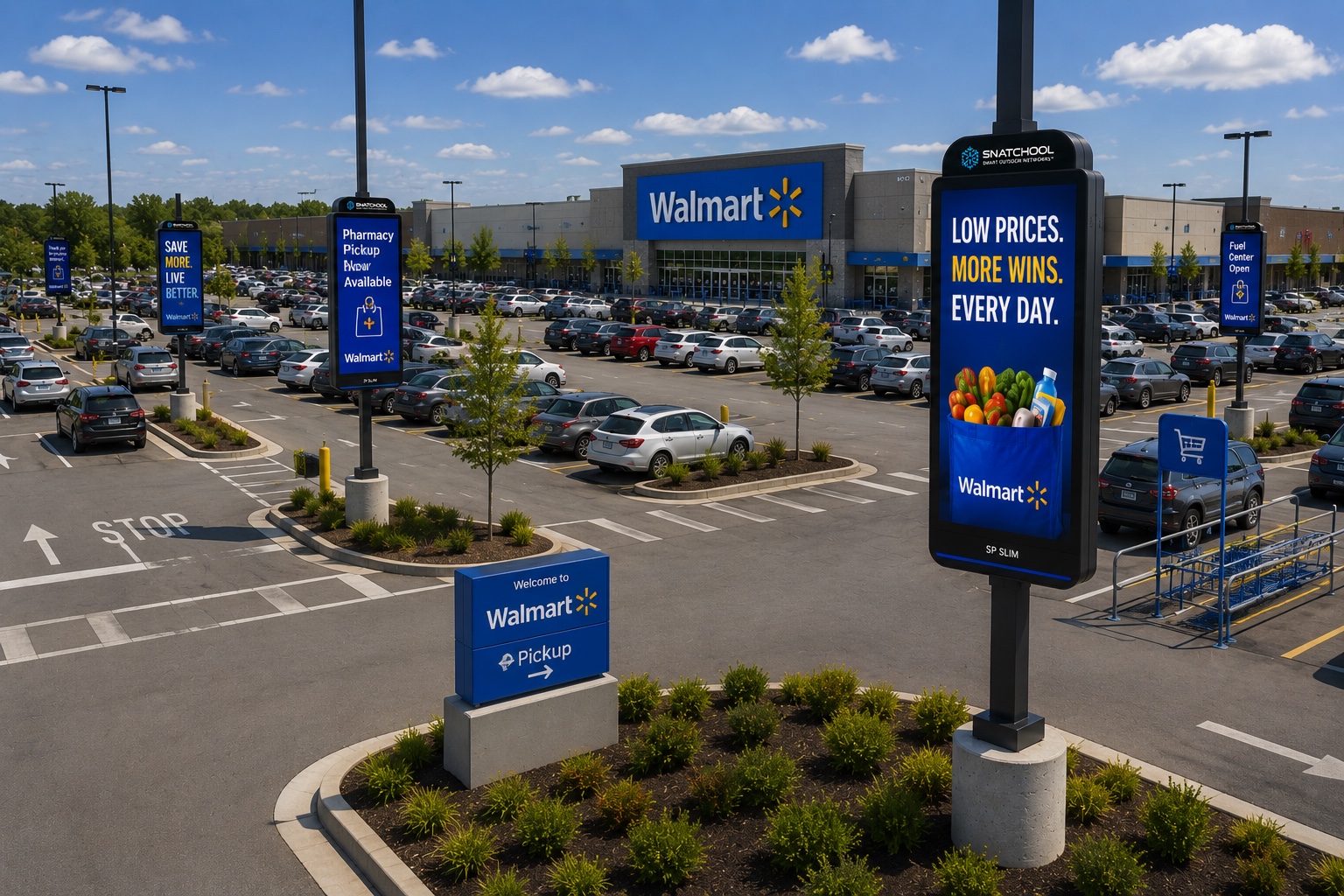
Built on SP Slim™ and Smart Palm™, the network becomes part of the daily environment: visible at the bus stop, the parking lot, the plaza, the arrival corridor. Residents learn what it is by seeing it work — not by being asked to install something.
Why daily presence matters for emergency messaging
Emergency communication only works if people recognize the channel. A display that residents pass every day, carrying useful neighborhood information, becomes a trusted source. When that same display switches to a severe weather alert, residents read it. They don't dismiss it as a sign they've never noticed before.
First Contact Community Awareness™ — the operating principle behind every Snatchool deployment — depends on this. The first point of contact has to be familiar. Familiarity comes from daily use, not from emergency drills.
What runs on the network day-to-day
Civic content fills the network between priority events. Public works publishes service updates and project notifications. Parks promotes programs and events. Transit posts route changes. Public health communicates seasonal guidance. Tourism boards highlight neighborhood districts. Cultural affairs surfaces events at community venues.
None of this content competes with emergency messaging because the platform's priority routing ensures emergency content takes over instantly when published. The civic layer is what fills the space the rest of the time.
Neighborhood-scale targeting
Community Awareness Networks™ are not citywide broadcast systems. They're place-based: a unit in one corridor publishes content relevant to that corridor. A waterfront unit carries beach safety and tide information. A downtown unit carries event and parking information. A residential corridor carries neighborhood-specific civic content.
Place-based targeting is what makes the network valuable to residents on an ordinary day, which is what makes it credible on the day it matters most.
How cities operate a Community Awareness Network™
Operations are typically shared across a small group of trained municipal staff: the communications office curates the editorial calendar, departments publish into their authorized channels, and the public safety office holds the priority override role for emergency content.
The Snatchool platform handles the operational mechanics — templates, scheduling, geographic routing, publishing controls, audit logs — so staff time is spent on what to say, not on how to publish it.
- Community Awareness Networks™ run continuously, not only during emergencies.
- Daily presence is what makes residents recognize and trust emergency messaging when it appears.
- The platform supports civic, public health, transit, parks, and event content alongside the priority safety channel.
- Content is place-based — neighborhood units carry neighborhood-relevant programming.
- Operations are shared across trained municipal staff with role-based publishing.
Frequently Asked Questions
An emergency alert system only activates during emergencies. A Community Awareness Network™ runs continuously, carrying civic information, neighborhood programming, and the priority safety channel — so residents recognize the network and pay attention when emergency content appears.
Civic announcements, public works notifications, parks programming, transit updates, public health messaging, event promotion, and neighborhood information — alongside the managed advertising layer that funds operations.
No. The platform supports place-based targeting so each unit carries content relevant to its corridor, neighborhood, or district. Citywide alerts are also supported when needed.
Bernard M. Albury Jr. is the founder of Snatchool Innovations LLC and the architect behind the SP Slim™ and Smart Palm™ outdoor communication platforms. He developed the First Contact Community Awareness™ operating principle that governs every Snatchool deployment and the Municipal Digital Messaging™ framework that coordinates public safety, civic information, and managed advertising into a single outdoor channel.