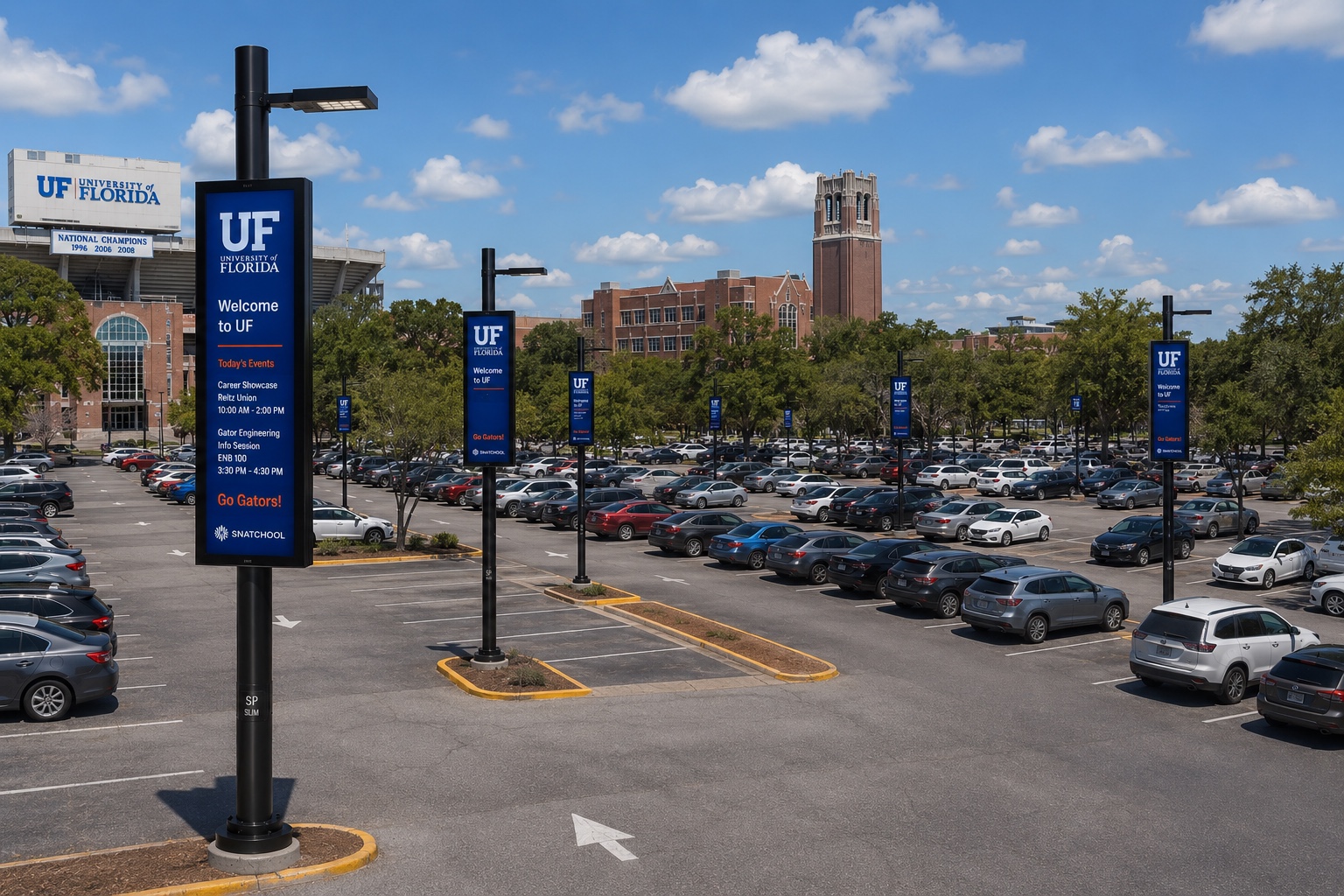
First Contact Community Awareness™ is the operating principle behind every Snatchool deployment. It sounds simple — the first message belongs at the first point of contact — but it has specific operational consequences that shape where infrastructure deploys, what it carries, and how it's operated. This article explains the principle and what it means in practice.
The principle
First Contact Community Awareness™ holds that important information should reach people at the earliest, most visible points of their daily movement — not buried in an app, not posted on a wall they pass without seeing, not assumed to be found later. The first point of contact is the threshold between private space and public space: sidewalks, entrances, parking lots, plazas, transit stops, arrival corridors.
The principle is operational, not aesthetic. It dictates that communication infrastructure has to physically exist in those locations, weather-rated and always-on, because that's where the first contact actually happens.
Why the threshold matters
Communication at the threshold reaches the population that no other channel reaches reliably: people in motion, people without the app, visitors, transit riders, families on foot. The threshold is also the moment when information is most actionable — at the entrance to a venue, before someone parks, when they're deciding which way to walk.
Communication delivered after the threshold has been crossed is fundamentally different. Indoor signage assumes the person is already inside. App notifications assume the person has the app open. Threshold messaging assumes only that the person is in the public realm, which is the only assumption that scales.
What this means for deployment design
First Contact Community Awareness™ shapes deployment choices directly. SP Slim™ units deploy on pedestrian-scale poles at the threshold of public space — corridors, parking entries, plazas, transit stops. Smart Palm™ structures anchor landmark thresholds — civic plazas, arrival points, district entrances. The form factors are different because the environments are different; the placement principle is the same.
It also shapes what runs on the network. Threshold messaging is by definition concise — readable in seconds, relevant to the moment, written for outdoor viewing. The platform's templates and editorial standards enforce that.
What this means for operations
Operationally, First Contact Community Awareness™ means the network has to be reliably present. A display that's offline isn't communicating; a unit that's blank isn't at the threshold. The platform's monitoring, maintenance program, and service workflows exist to enforce continuous presence — because intermittent infrastructure violates the principle.
It also means the network has to be ready to carry safety content the moment it's needed. The priority routing, role-based authorization, and integration with emergency management workflows are all consequences of the operating principle, not features bolted on afterward.
The principle in three sentences
Important information belongs at the first point of contact. The first point of contact is the threshold of public space. Communication infrastructure should be designed, deployed, and operated to be there reliably.
- First Contact Community Awareness™ holds that information belongs at the first point of contact — the threshold of public space.
- Threshold messaging reaches the population no other channel reaches reliably.
- The principle shapes deployment choices: SP Slim™ at pedestrian thresholds, Smart Palm™ at landmark thresholds.
- It also shapes operations: continuous presence, priority routing, verified origination.
- It is the operating principle behind every Snatchool deployment, not a marketing slogan.
Frequently Asked Questions
It is the operating principle that important information belongs at the first point of contact — the threshold between private and public space — and that communication infrastructure should be deployed there reliably.
Indoor signage assumes the audience is already inside. Threshold messaging assumes only that the audience is in the public realm, which is where the first point of contact actually occurs.
Yes. SP Slim™ and Smart Palm™ are different form factors for different environments, but both are deployed at the threshold of public space according to the same operating principle.
Bernard M. Albury Jr. is the founder of Snatchool Innovations LLC and the architect behind the SP Slim™ and Smart Palm™ outdoor communication platforms. He developed the First Contact Community Awareness™ operating principle that governs every Snatchool deployment and the Municipal Digital Messaging™ framework that coordinates public safety, civic information, and managed advertising into a single outdoor channel.