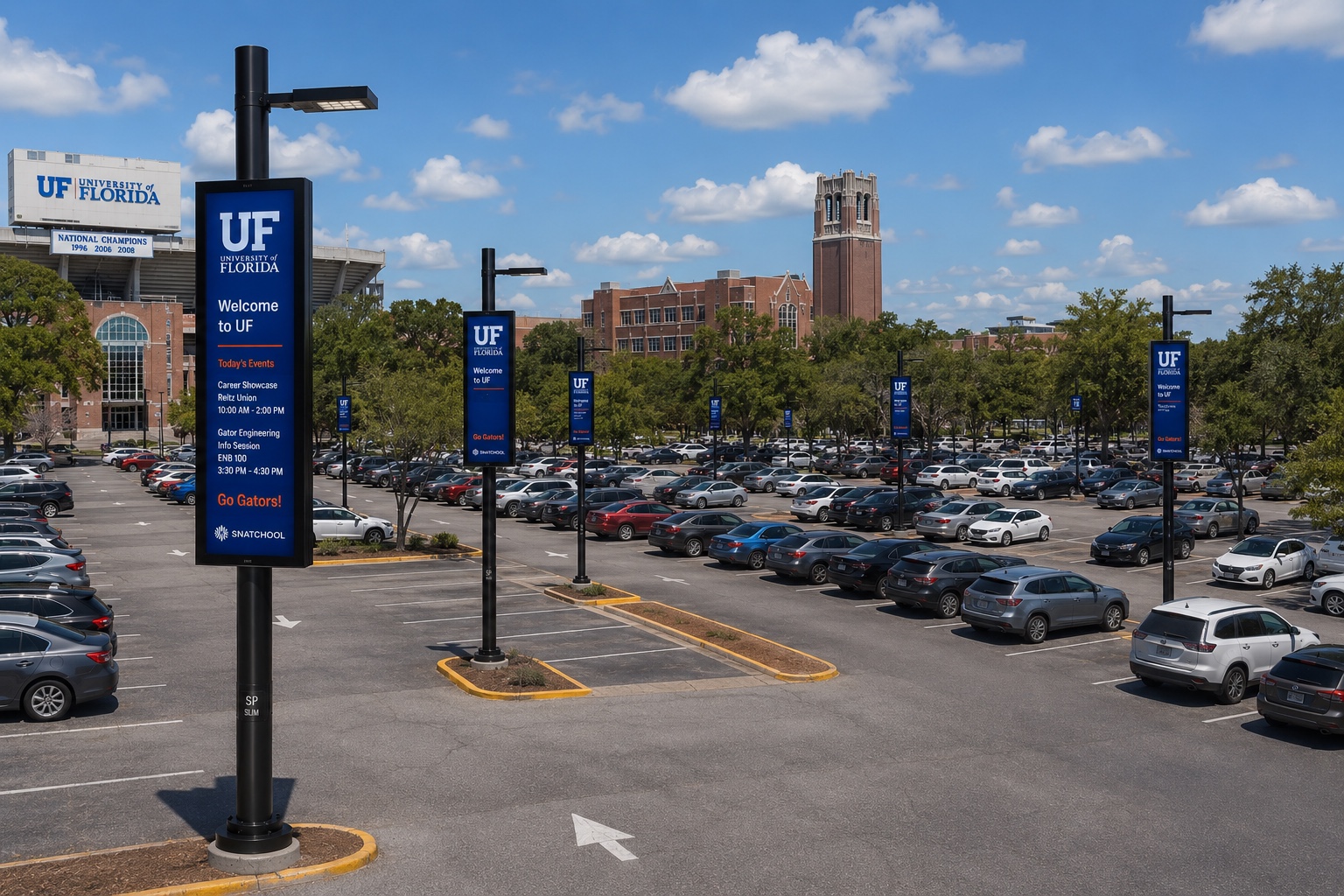
Most municipal public safety communication infrastructure was built for indoor and on-device delivery: sirens for tornadoes, apps for everything else. The category that's missing is outdoor visual messaging at street level — the channel that reaches pedestrians, transit riders, parents in parks, and visitors who never installed the city app. That's the gap the Snatchool SP Slim™ network fills, and it's why First Contact Community Awareness™ is built into every deployment.
The categories of public safety communication
Public safety communication breaks into four operational categories. Sirens deliver attention-grabbing audio for a narrow set of events, mostly weather. Apps and SMS deliver detailed information to opted-in device holders. Broadcast media delivers extended context for major events. Outdoor visual messaging delivers timely, location-specific information to anyone in the public realm.
Most cities have the first three. Outdoor visual messaging is the category that's typically missing — not because it isn't needed, but because dedicated infrastructure for it didn't exist as a standard category until purpose-built platforms like SP Slim™ made it deployable at municipal scale.
Why outdoor messaging matters
The people most exposed to a developing emergency are outdoors, not at home with the TV on or at a desk with a notification panel. Pedestrians, transit riders, families at parks, visitors arriving at a venue, residents walking between buildings — all of them are in the public realm, with no guarantee of being reached by a device-based alert.
Outdoor visual messaging is the only channel that reaches that population reliably. A weather-rated display at street level works the same way a stoplight does — it's part of the environment, visible to everyone in it, independent of who they are or what they carry.
How priority routing works
On the Snatchool platform, public safety content has guaranteed priority routing. When an authorized public safety user publishes a priority alert, the platform overrides civic content and the managed advertising layer across the relevant units, in seconds, network-wide. The override is enforced at the platform level — it doesn't depend on calling anyone or coordinating with a contractor.
The platform also supports geographic scope. A localized incident is published only to the affected service area. A regional weather warning appears on every unit in the network. The same authorization framework handles both.
Verified, role-based origination
Public safety messages must be traceable. The Snatchool platform requires verified, role-based authentication for priority content. Only authorized users can issue overrides, and every published message is recorded — who published it, when, what units it ran on, and how long.
That audit trail is what makes the network safe to integrate with municipal emergency management workflows. It also makes after-action review straightforward, because the operational record is built into the platform.
Integration with emergency management workflows
Emergency managers shouldn't have to learn a new tool during an active incident. The Snatchool platform integrates with municipal emergency management workflows so priority publishing fits the process that's already in use. IPAWS, severe weather feeds, and AMBER/Silver alert workflows are supported categories.
The integration is designed to fail safe. If an upstream system isn't reachable, the platform supports manual publishing by the authorized role; if the network or a unit isn't reachable, the platform reports it. The operating posture is that the infrastructure is always observable and always operable.
What an outdoor public safety network is not
It is not a replacement for sirens, apps, or broadcast media. Those channels serve their populations. It is the missing fourth category — the channel that reaches everyone in the public realm regardless of opt-in status.
It is also not a digital sign. A digital sign is a display. A public safety communication network is operating infrastructure with authorization, routing, audit, and integration — managed by an organization with operational accountability for keeping it working.
- Outdoor visual messaging is the missing category in most municipal public safety communication.
- App and SMS alerts miss the population in the public realm — the population most exposed to events.
- The Snatchool platform enforces priority routing automatically across the network.
- Verified, role-based origination produces a complete operational audit trail.
- Integration with municipal emergency management workflows keeps the tool familiar during incidents.
Frequently Asked Questions
No. Apps, sirens, and broadcast media each serve their populations. Outdoor visual messaging is the missing category that reaches people in the public realm regardless of device or opt-in status.
Authorized priority content overrides other inventory across the relevant network units in seconds, enforced automatically by the platform.
Only verified, role-authorized public safety users. Every published message produces an audit record showing who published it, when, where, and for how long.
Yes. The platform integrates with municipal emergency management workflows including IPAWS, severe weather feeds, and AMBER/Silver alert categories.
The platform reports it. The operating posture is that the infrastructure is always observable so service issues are surfaced and addressed, not silently invisible.
Bernard M. Albury Jr. is the founder of Snatchool Innovations LLC and the architect behind the SP Slim™ and Smart Palm™ outdoor communication platforms. He developed the First Contact Community Awareness™ operating principle that governs every Snatchool deployment and the Municipal Digital Messaging™ framework that coordinates public safety, civic information, and managed advertising into a single outdoor channel.