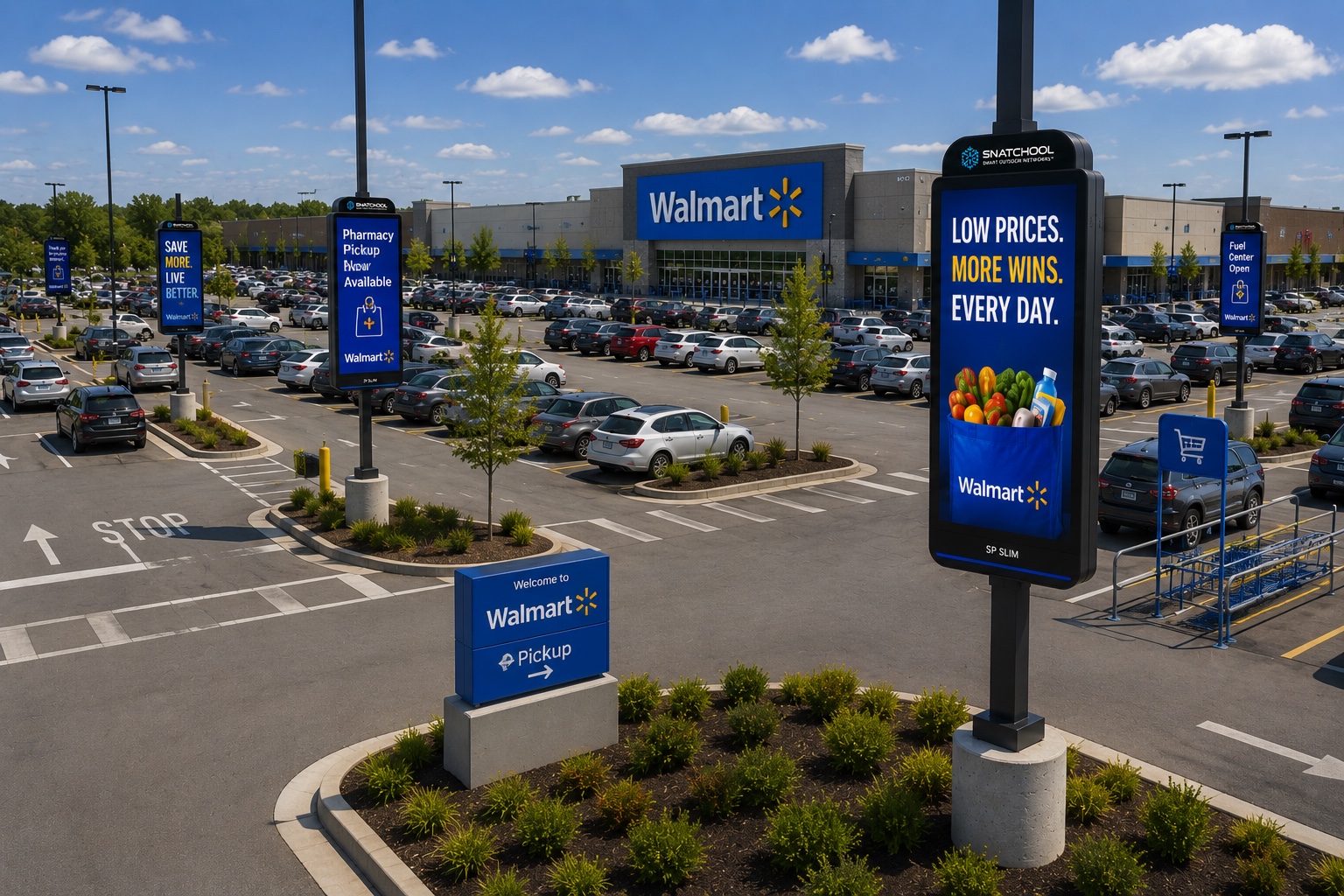
Most outdoor advertising is bought as inventory on individual structures: this billboard, this transit shelter, this kiosk. Territory-Based Advertising™ works differently. It treats the Snatchool network as coordinated infrastructure in a defined geographic territory, and lets brands run inside that territory on a managed, brand-safe layer of the same network that carries public safety and civic content.
What Territory-Based Advertising™ is
Territory-Based Advertising™ is the managed advertising model Snatchool operates on its SP Slim™ and Smart Palm™ networks. Brands buy presence in a defined territory — a city, a district, a corridor, a host property's surrounding area — rather than buying individual structures.
Inside that territory, the platform handles rotation, scheduling, geographic scope, and brand-safety category enforcement. The advertiser engages with the network as a coordinated channel, not as a list of standalone units.
Why territory matters
Brands operate in territories — service areas, market regions, store catchment zones. Territory-Based Advertising™ aligns the buying model with how brands actually think about their footprint, instead of asking them to assemble a custom plan around individual outdoor structures.
It also concentrates investment where it's relevant. A regional brand can run in the territories that match its business; a local brand can run inside the corridor where its customers are.
Brand safety on civic infrastructure
Because the Snatchool network is coordinated public-safety and civic infrastructure, the managed advertising layer runs inside a tightly defined editorial framework. Operators define category restrictions — no political, no adult, no categories that conflict with civic values — and the platform enforces them.
For brands, the result is a managed channel that is unambiguously brand-safe and that runs alongside genuinely useful community content, not adjacent to content the brand would rather not be near.
How buying works
Advertisers engage Snatchool directly through the managed advertising channel. The team handles creative review against the platform's templates, scheduling within the territory, and reporting against the campaign. Because Snatchool operates the network, there is no third-party media owner to negotiate with separately.
Creative is reviewed for fit with the templates that keep the network legible at street level. That review is part of the brand-safety framework — both for the advertiser and for the operator of the network.
How it differs from billboard buys
Buying outdoor billboards typically means selecting individual structures from a media owner's inventory, with the inventory itself oriented toward highway viewing and advertising as the only content. Territory-Based Advertising™ is a coordinated managed layer on city-aligned communication infrastructure built for the pedestrian environment.
Different goal, different audience, different operating model. Territory-Based Advertising™ is the buying side of a communication-first network.
- Territory-Based Advertising™ sells presence in defined geographic territories, not individual structures.
- Brands buy at the threshold of public space, on infrastructure designed for the pedestrian environment.
- The managed advertising layer is enforced as brand-safe by platform-level category restrictions.
- Advertisers engage Snatchool directly; there is no third-party media owner.
- Creative review against platform templates is part of the brand-safety framework.
Frequently Asked Questions
It is the managed advertising model Snatchool operates on its SP Slim™ and Smart Palm™ networks. Brands buy presence in a defined geographic territory rather than buying individual outdoor structures.
Billboard buys select individual structures from a media owner's inventory. Territory-Based Advertising™ sells coordinated presence inside a defined territory on a communication-first network that also carries public safety and civic content.
Category restrictions are defined by the operator of each network and enforced at the platform level. Creative is reviewed for fit with the templates that keep the network legible at street level.
Advertisers engage Snatchool directly through the managed advertising channel. Snatchool operates the network end to end, so there is no third-party media owner to negotiate with separately.
Bernard M. Albury Jr. is the founder of Snatchool Innovations LLC and the architect behind the SP Slim™ and Smart Palm™ outdoor communication platforms. He developed the First Contact Community Awareness™ operating principle that governs every Snatchool deployment and the Municipal Digital Messaging™ framework that coordinates public safety, civic information, and managed advertising into a single outdoor channel.