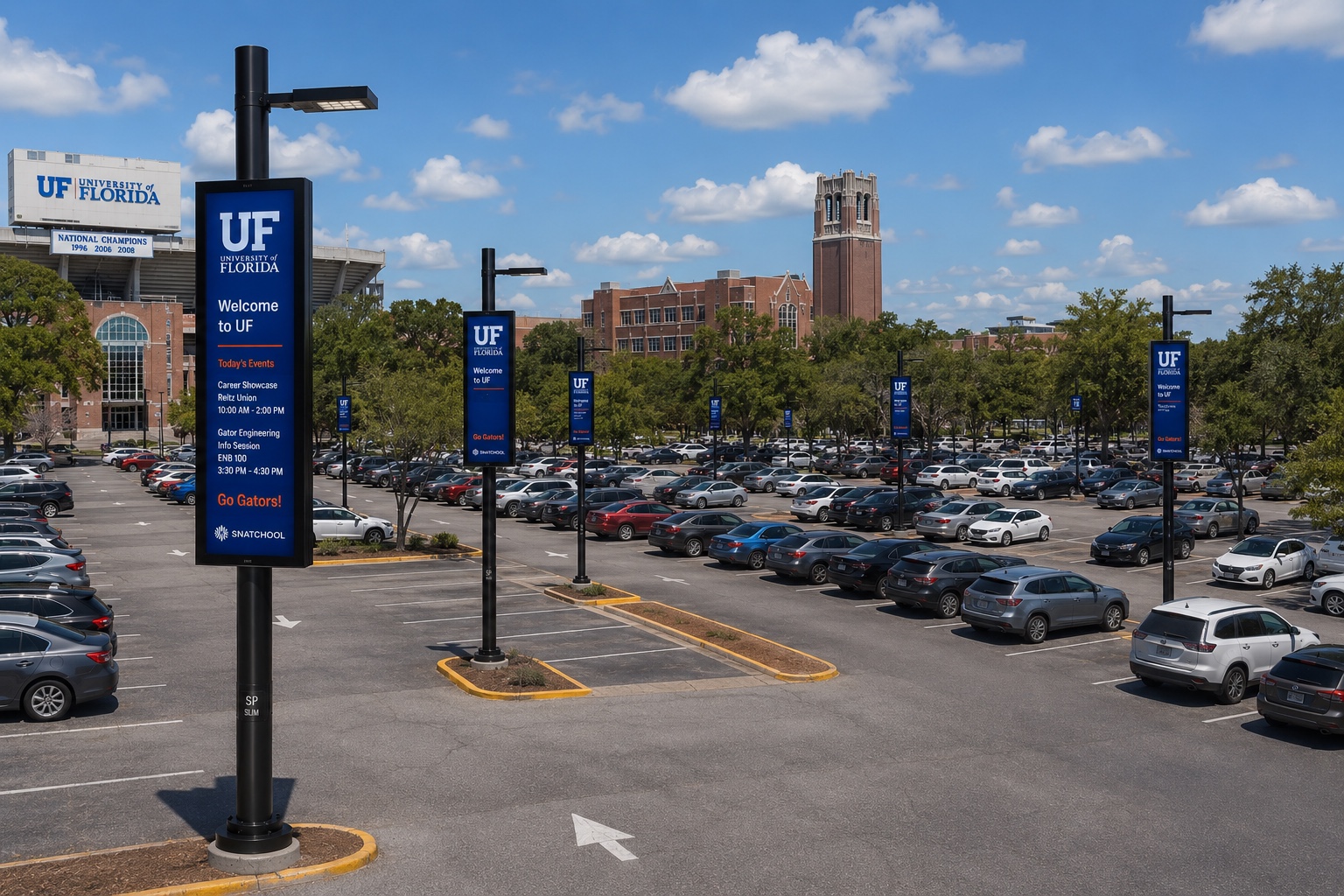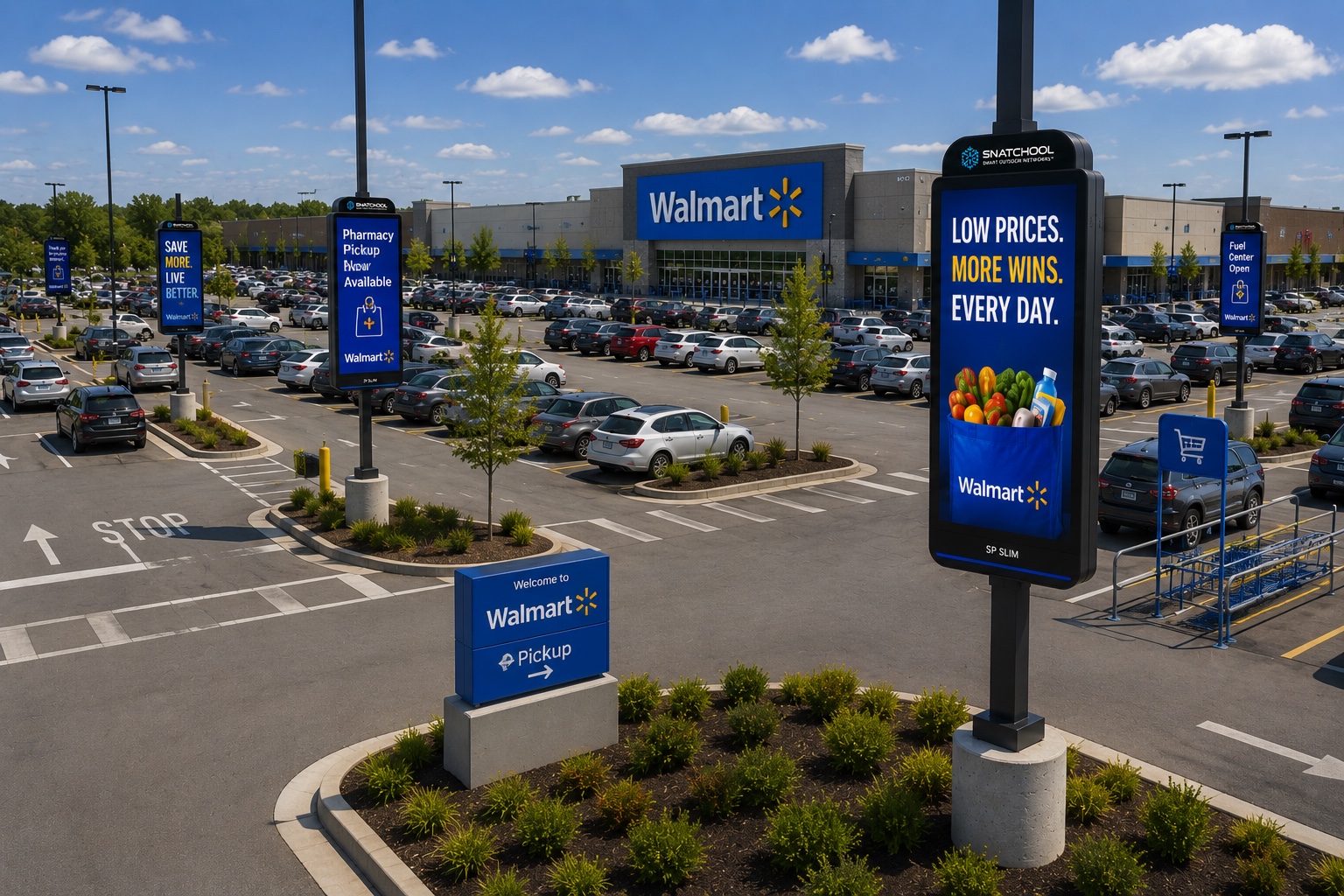
Outdoor digital signage is a broad category, and most of what people picture when they hear the term — highway billboards, mall-style digital posters, transit dioramas — is not what SP Slim™ is. The differences are not cosmetic; they go to form factor, operating model, and what the display is for.
Form factor: built for the pedestrian environment
Traditional outdoor digital signage was scaled for highway viewing or as standalone freestanding kiosks. SP Slim™ is scaled for the pedestrian environment — slim profile, pole-mounted, sized to be visible without dominating the streetscape.
That difference is what makes SP Slim™ welcome in pedestrian corridors, parking areas, residential-adjacent commercial blocks, and civic plazas where larger formats would face opposition.
Operating model: communication-first, not advertising-first
Traditional outdoor digital signage is typically owned and operated by a media company that leases inventory and controls content. SP Slim™ is operated as municipal or property-side communication infrastructure. Managed advertising is one of three coordinated content layers — alongside public safety and civic content — not the purpose of the network.
That inverts the relationship. The city or property owner is the operator. Advertising is a funding mechanism inside an editorial framework they define.
Governance: priority routing and category control
Most billboard-style networks have no built-in mechanism to clear inventory for an emergency. SP Slim™ runs on a platform with priority routing — authorized public safety users can take the network into safety mode network-wide in seconds — and with operator-defined category restrictions enforced at the platform level.
Governance isn't a contract clause; it's an operational property of the platform.
Deployment economics
Traditional outdoor digital signage often involves dedicated structures, new foundations, and concentrated capital expense at a small number of high-visibility sites. SP Slim™ deploys on existing pole infrastructure and scales by adding units, not by building new structures.
The result is a network that grows with usage and need, rather than a small number of large assets that have to justify their footprint individually.
- SP Slim™ is sized for the pedestrian environment, not highway-scale viewing.
- It is operated by the city or property owner as communication infrastructure, not leased as advertising inventory.
- Priority routing and category control are built into the platform, not bolted on.
- Deployment uses existing pole infrastructure and scales unit by unit.
- The display exists to serve communication; advertising funds that capability.
Frequently Asked Questions
No. SP Slim™ is communication infrastructure with a managed advertising layer. A digital billboard is advertising infrastructure operated by a third-party media company.
Interior digital signage reaches people already inside a building. SP Slim™ reaches the public realm — pedestrians, drivers, transit riders — at the threshold of the environment, before they would see interior signs.
SP Slim™ is not a billboard replacement. It is a different category of infrastructure designed for the pedestrian environment and for shared multi-department use.
Bernard M. Albury Jr. is the founder of Snatchool Innovations LLC and the architect behind the SP Slim™ and Smart Palm™ outdoor communication platforms. He developed the First Contact Community Awareness™ operating principle that governs every Snatchool deployment and the Municipal Digital Messaging™ framework that coordinates public safety, civic information, and managed advertising into a single outdoor channel.